How can we teach fact-checking and critical thinking in schools? (Free training for teachers)
A joint project between MotiMore and ELTE (Eötvös Lóránd University) TINLAB has been successfully completed – a professional collaboration in which research and pedagogical practice came together.
The development was based on the cooperation of two key contributors: the MotiMore team and the AdaPsyd research group, involved through ELTE TINLAB and led by PhD Csilla Kálózi-Szabó. The handbook jointly developed by the research group and Abacusan Studio provided a solid professional foundation for creating an online learning material within the MotiMore system that is both credible and easy to integrate into everyday teaching practice.

“Odd ones” in the classroom – how can we recognize and support them?
Today, almost every teacher encounters students whose development differs in some way from the norm. These differences are not always obvious, yet they can significantly influence a child’s behavior, learning, and classroom dynamics.
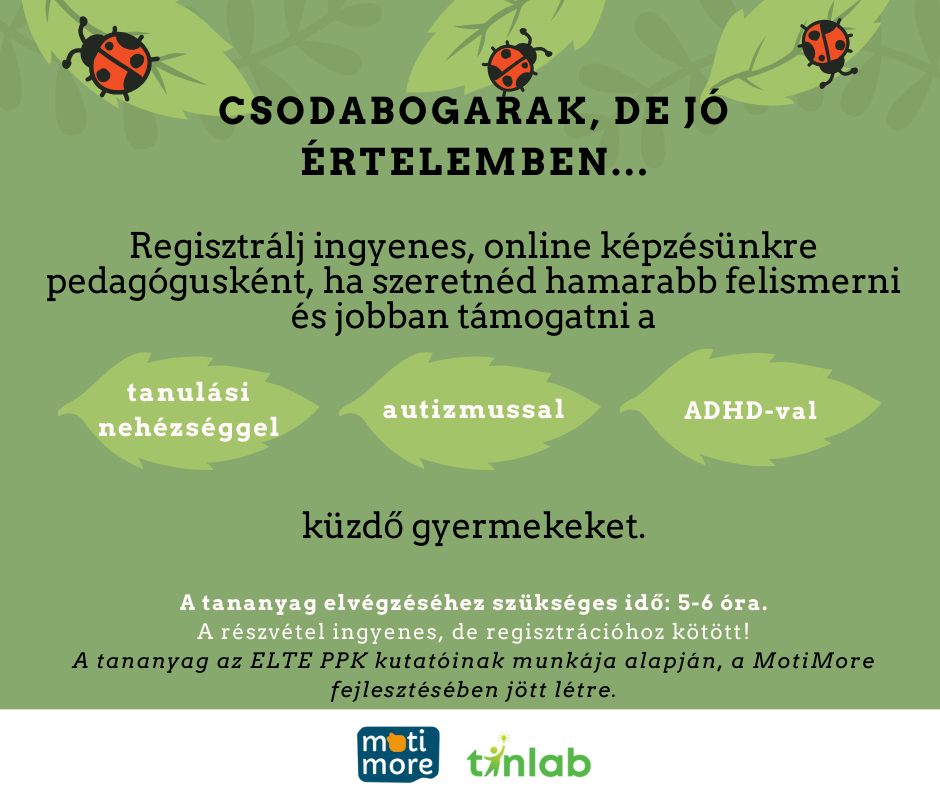
The resulting online course consists of 4 modules and takes approximately 5–6 hours to complete. Its goal is to help teachers better understand students with atypical developmental paths and to provide practical tools for everyday teaching. Participants in the training were introduced to autism spectrum disorder, ADHD, and various learning difficulties, while also gaining a new perspective on students often referred to as “odd ones” – who, in reality, simply function differently.
Interest in the training was outstanding: a total of 637 people registered. Although the course is not (yet) accredited, participants were provided with a certificate. More than 200 teachers took part in the related webinars, clearly demonstrating how timely and important this topic is in education.
The developed learning material remains available beyond the organized training. You can apply by emailing info@motimore.com, and it can also be accessed via the links below (however, certificates can only be issued to registered participants).
Moduls are available here:

Prepared within the framework of the project “National Laboratory for Social Innovation” (ID: RRF-2.3.1-21-2022-00013), as part of Hungary’s Recovery and Resilience Plan, with the support of the European Union’s Recovery and Resilience Facility.